

Hearing is an important part of everyday communication. We use it to understand conversations, respond to instructions, enjoy music, stay aware of our surroundings, and connect with family and friends. However, hearing loss does not always appear suddenly. In many cases, the changes develop slowly, making them difficult to recognise in the early stages.
You may notice yourself asking others to repeat what they said, increasing the television volume, or finding conversations difficult in busy environments. For children, the signs may be different and can include delayed speech, inconsistent responses to sounds, or difficulty following verbal instructions.
Recognising these changes early can help you decide whether a hearing assessment is appropriate. Hearing Loss Treatment in Nairobi depends on the type, severity, and possible cause of hearing loss. A professional assessment is therefore an important first step before deciding what support may be suitable.
What Is Hearing Loss?
Hearing loss means a person has reduced ability to hear sounds compared with the expected level for their age and circumstances. It can affect one ear or both ears and may range from mild difficulty hearing softer sounds to more significant hearing challenges.
Hearing loss can occur at different stages of life. Children may experience hearing difficulties because of factors affecting early development, while adults may notice changes associated with age, repeated exposure to loud sounds, ear conditions, or other factors.
Not everyone experiences hearing loss in the same way. Some people may hear sounds but struggle to understand speech clearly, especially when there is background noise. Others may have difficulty hearing quiet sounds or noticing sounds coming from a particular direction.
A hearing assessment can help determine what type of hearing difficulty may be present and whether further hearing care is needed.
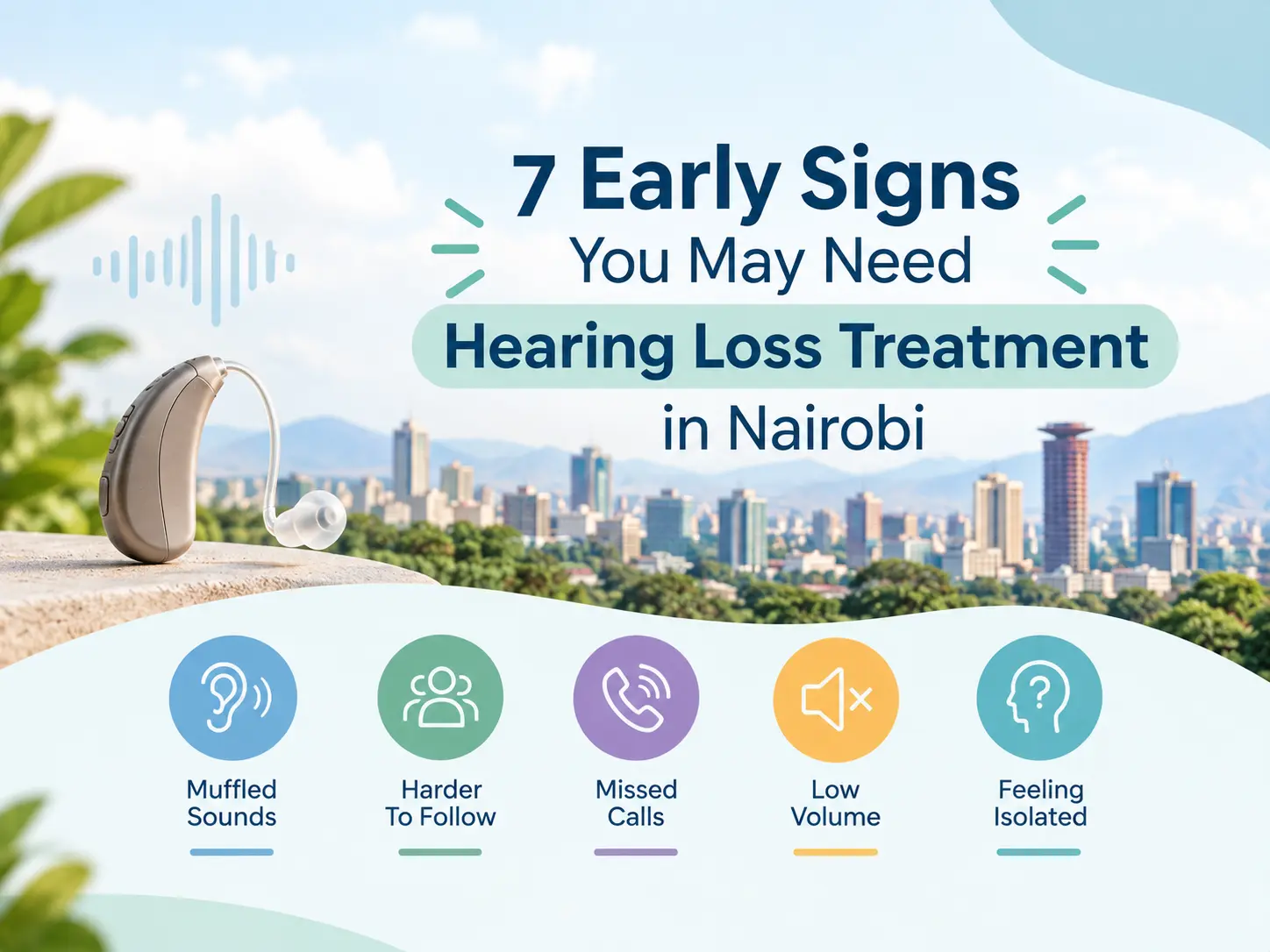
7 Early Signs You May Need Hearing Loss Treatment in Nairobi
1. You Frequently Ask People to Repeat Themselves
One of the most common signs is regularly asking people to repeat what they have said. You may understand some parts of a conversation but miss particular words or sentences.
This can become more noticeable when someone speaks softly, quickly, or from another room. If this happens frequently rather than occasionally, it may be worth having your hearing checked.
2. You Keep Increasing the Television or Phone Volume
Do you regularly turn up the television, radio, headphones, or phone volume? If family members or friends mention that the volume is unusually loud, this may be a sign that you are having difficulty hearing at a comfortable level.
People sometimes adjust to gradual hearing changes without realising that their listening habits have changed. A hearing assessment can provide a clearer picture of your current hearing ability.
3. Conversations Become Difficult in Noisy Places
Understanding speech in a crowded restaurant, busy office, family gathering, or other noisy environment can be challenging when hearing is reduced.
You may hear that someone is talking but struggle to distinguish their words from background sounds. You might also depend more heavily on watching the speaker’s face or asking for information to be repeated.
This is an important reason to consider Audiology and Hearing Care in Nairobi, particularly when these difficulties are affecting everyday communication.
4. You Have Difficulty Following Conversations or Instructions
Hearing difficulties can sometimes make conversations feel exhausting. You may miss parts of discussions, misunderstand questions, or have trouble following instructions when information is delivered verbally.
For adults, this may affect communication at home, work, or social gatherings. For children, difficulty hearing spoken information may sometimes appear as a problem with listening or following directions.
A hearing assessment can help determine whether hearing is contributing to these concerns.
5. Your Child Has Delayed Speech or Language Development
For children, hearing is closely connected with speech and language development. A child learns many speech sounds by listening to the people around them.
If a child does not respond consistently when called, does not appear to notice certain sounds, uses fewer words than expected, or has difficulty understanding spoken instructions, hearing should be considered as one possible factor.
This does not automatically mean that the child has hearing loss. There can be many reasons for differences in speech and communication development. However, checking hearing can provide useful information.
When communication difficulties are also present, Speech Therapy in Nairobi may be considered as part of a broader support approach.
6. You Frequently Miss Everyday Sounds
Some hearing changes become noticeable through everyday sounds rather than conversations.
For example, you may fail to notice a doorbell, telephone ringing, an alarm, traffic sounds, or someone calling from another room. These signs can be particularly easy to overlook when hearing loss develops gradually.
If you or your child regularly misses sounds that others notice, a hearing assessment may help determine whether reduced hearing is involved.
7. You Avoid Conversations or Social Situations
When conversations become difficult to follow, communication can require more concentration and effort. Some people may eventually feel uncomfortable participating in group discussions or social activities.
You may find yourself sitting closer to the person speaking, relying on lip movements, or avoiding noisy gatherings altogether.
Addressing hearing concerns early may help you understand what is making communication difficult and what forms of support may be appropriate.
What Causes Hearing Loss?
Hearing loss can have different causes, and the reason is not always immediately obvious. Some common factors can include:
- Age-related changes in hearing
- Long-term exposure to loud sounds
- Ear infections or other ear-related conditions
- Certain injuries or medical conditions
- Genetic or developmental factors
- Problems affecting the outer, middle, or inner ear
Because there can be several possible causes, self-diagnosis is not recommended. A professional hearing assessment can help provide more specific information.
Why Is Early Hearing Assessment Important?
Many people wait until hearing difficulties become noticeable to others before seeking an assessment. However, identifying a concern earlier can provide useful information about what is happening.
For children, early identification can be particularly important because hearing is connected with speech, language, learning, and social interaction. Understanding a child’s hearing ability may help parents and professionals make more informed decisions about additional support.
For adults and seniors, hearing difficulties can affect conversations, workplace communication, family interactions, and participation in everyday activities.
Early assessment does not necessarily mean that a person will require hearing aids or another specific treatment. The appropriate next step depends on the assessment findings and individual circumstances.
What Happens During a Hearing Assessment?
A hearing assessment may involve different checks depending on the person’s age, communication ability, symptoms, and hearing history.
The audiology professional may ask about hearing concerns and everyday listening difficulties before carrying out appropriate hearing tests. The assessment may help identify the level and type of hearing difficulty.
For young children, the approach may be adapted to make the assessment comfortable and suitable for their developmental stage.
The results can then help explain whether hearing loss is present and whether further evaluation, hearing devices, rehabilitation, monitoring, or other support should be considered.
Can Hearing Loss Affect Children With Developmental Needs?
Children with developmental conditions may have communication, attention, sensory, or behavioural differences that can sometimes make hearing concerns harder to recognise.
For example, a child may not consistently respond to their name or spoken instructions for several possible reasons. It is therefore useful to consider hearing as part of a broader understanding of the child’s needs.
ABA Therapy in Nairobi may support children with Autism in areas such as communication, behaviour, learning, and functional skills. However, hearing assessment serves a different purpose and can help determine whether hearing difficulties are also present.
Similarly, Occupational Therapy in Nairobi may support sensory processing, daily living abilities, motor skills, and participation in everyday activities. Different services can work alongside one another when a child’s individual needs require broader developmental support.
When Should You Consider Hearing Loss Treatment in Nairobi?
Consider seeking professional hearing guidance if hearing difficulties are persistent or begin affecting communication, learning, work, social participation, or everyday activities.
For children, parents may want to consider an assessment when there are concerns about responses to sounds, speech development, listening behaviour, or understanding spoken information.
For adults, repeated requests for others to speak louder, difficulty hearing in meetings, increasing television volume, or struggling with conversations in noisy environments may be reasons to seek an assessment.
Hearing Loss Treatment in Nairobi should be based on an individual’s hearing assessment rather than assumptions about the cause or type of hearing difficulty.
Hearing Care at RDCC Healthcare
At RDCC Healthcare, hearing concerns are approached according to the individual’s age, communication abilities, hearing history, and everyday listening needs.
The aim is to understand the person’s hearing abilities and provide appropriate guidance based on the assessment findings. Hearing care may be relevant for children, adults, and seniors experiencing different types of hearing concerns.
For children with speech, communication, or developmental concerns, hearing information can also provide useful context when considering other services such as speech and language support.
If you have noticed ongoing changes in hearing, getting a professional assessment can be a practical first step toward understanding what may be happening.
Frequently Asked Questions
1. What are the early signs of hearing loss?
Common signs include frequently asking people to repeat themselves, increasing television volume, difficulty understanding speech in noisy places, missing everyday sounds, and struggling to follow conversations.
2. When should I get a hearing test?
A hearing assessment may be appropriate when hearing difficulties continue, become noticeable in everyday situations, or begin affecting communication, learning, work, or social activities.
3. Can children have hearing loss without obvious symptoms?
Yes. Some children may have subtle hearing difficulties. Delayed speech, inconsistent responses to sounds, difficulty following verbal instructions, or frequently misunderstanding spoken information may be reasons to consider a hearing assessment.
4. Can hearing loss affect speech and language development?
Hearing provides children with important information about speech sounds and spoken language. If hearing is reduced, it may sometimes affect how a child hears and learns speech and language.
5. Is hearing loss treatable?
The appropriate approach depends on the type and cause of hearing loss. Depending on individual findings, support may include medical care, hearing devices, rehabilitation, monitoring, or other appropriate interventions.
Yes. Difficulty following conversations can make social situations more challenging or tiring. Some people may avoid group conversations or noisy environments because they find communication difficult.
7. Where can I get Hearing Loss Treatment in Nairobi?
RDCC Healthcare provides hearing assessment and hearing care services in Nairobi for children, adults, and seniors. The appropriate support is considered according to individual hearing needs and assessment findings.

Related Posts
Top 5 Speech Therapists in Godhra
Speech and language difficulties can affect how a person shares ideas, learns new words, or…
Top 10 Speech Therapists in Bharuch
Good communication can make everyday interactions easier at home, school, work, and in social settings.…






