

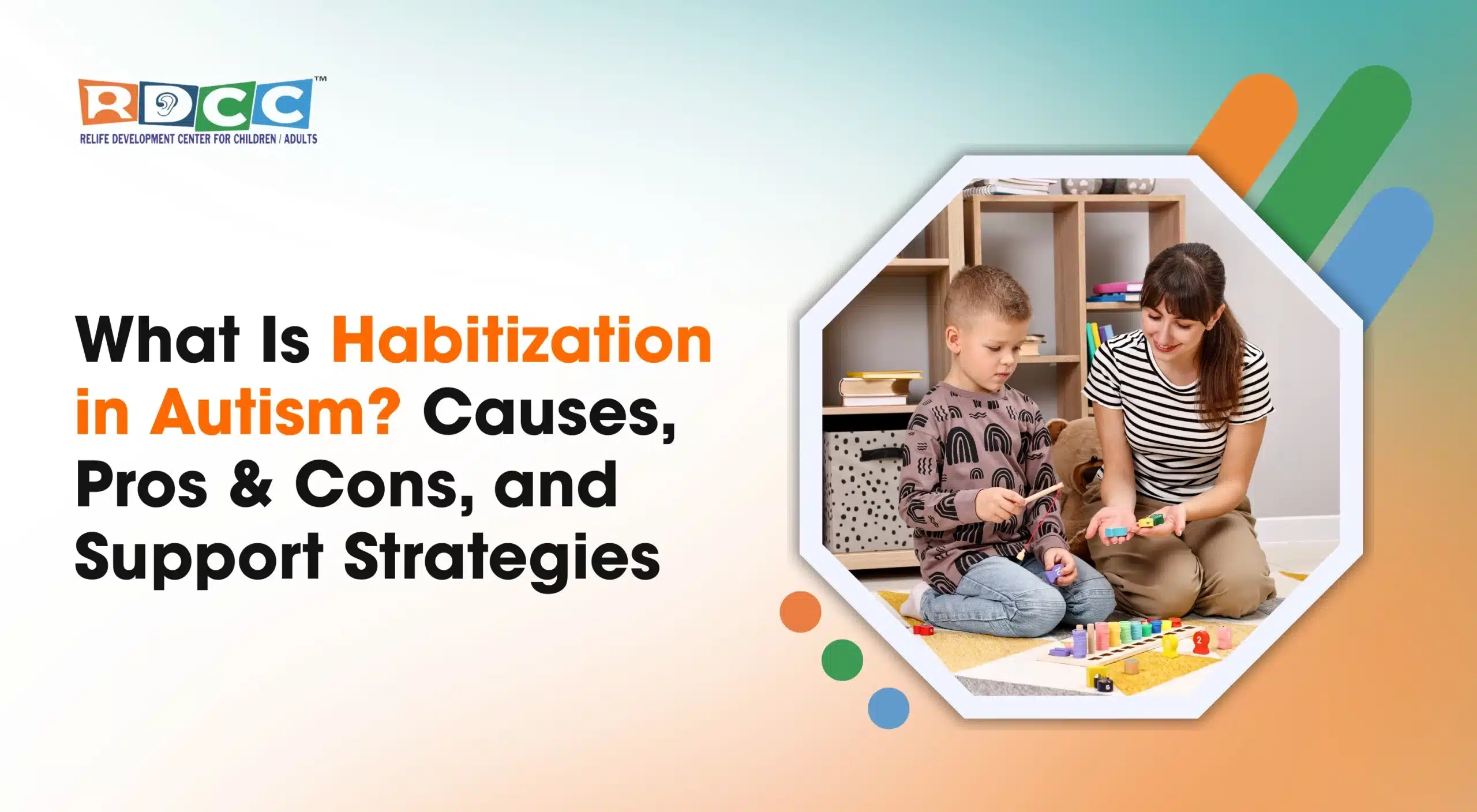
Habitization is not some clinical disorder but a more descriptive concept observed commonly in Autistic adults, or in some cases in researchers. A Person accustomed to habituation tends to depend upon fixed schedules, routines, and habits without any scope for flexibility.
These behaviours are their usual way of managing and systematically organising their day-to-day life, and save them from emotional and sensory turmoil.
These behaviours are their usual way of managing and systematically organising their day-to-day life, and save them from emotional and sensory turmoil.
This concept is somehow related to a few of the established concepts in Autism.
- Restricted, repetitive patterns of behaviour, interests, or activities (RRBs) – one of the core diagnostic criteria in DSM-5 and ICD-11
- Reluctant to flexibility
- Intense need for predictability in an unpredictable world
- Executive functioning difficulties
- Self-reliance to develop a coping mechanism
This proves that people with autism memorise a certain way of living through the same repetitive routines, may it’s the way they dress, the food they eat, or the way they interact with people around them. Because eventually, this predictable schedule somehow helps in lowering their cognitive and emotional stress.
Also Read: Behavioral Therapy Techniques: Methods for Autism and ADHD
What is Habitization, and Why Does It Happen in Autistic Persons
“Habitization” is a process by which a person gets extremely comfortable with a repetitive routine/behaviour/activities, etc.
Several neurological, sensory, and emotional factors contribute to habitization. Understanding these causes helps caregivers support children with empathy and effective strategies.
Main Causes and Underlying Reasons
- Executive functioning differences. Difficulty with cognitive flexibility, working memory, initiation, and planning makes improvisation exhausting or impossible.
- Sensory processing differences. Habits create a predictable sensory environment (same textures, sounds, lighting, smells), reducing sensory overload or meltdown risk.
- Anxiety and emotional regulation. Uncertainty triggers intense anxiety; routines act as an external “emotional regulator.”
- Information-processing style Autistic brains often excel at systemising and pattern recognition. Building explicit habits compensates for a weaker understanding and awareness.
- Reduced interoceptive awareness. Some autistic people have trouble noticing hunger, fatigue, thirst, etc., so external cues (eating at exactly 12:30) replace unreliable internal signals.
- Learned coping mechanism. Over the years, the person discovers that strict routines prevent shutdowns, meltdowns, or social mistakes, so the strategy becomes reinforced.
Other than all these factors, social interaction is a major issue faced by Autistic adults and children. To overcome this, some simple tips are explained in the blog.
Read Also: Social Skills for Kids with Autism: Activities That Really Work
Pros of Habitization
| Benefits | Reasons |
| Reduce instances of meltdowns/anxiety | Habit introduces predictability, and this predictability calms their nervous system. |
| Increase reliability | The same repetitive habits/ patterns result in fewer mistakes. |
| Introduce Self-regulation | Autistic persons are usually very particular about their daily tasks. |
| Conserve energy | Autistic persons show more towards specific tasks, thus saving energy by not indulging in multitasking. |
| Identity and joy | Special tasks/activities or interactions bring immense joy. |
Cons of Habitization
| Drawbacks | Reasons |
| Rigid habits | Some tasks/places require flexibility, thus rigid habits can act as an obstacle. |
| Vulnerability to predictability | If a certain routine/task didn’t follow the usual flow, then it can lead to irritation, anxiety, etc. |
| Health risk | The same dietary habits and choices can result in certain multivitamin deficiencies. |
| Social awkwardness | Due to the few interaction chances of social isolation is high. |
| Over-reliance | Parents/teachers/caregivers may feel held hostage by the child’s stubborn choices due to their over-dependence. |
How to Support Flexible Growth Without Breaking Helpful Habits
The goal is never to eliminate habitization—many habits are lifelong strengths—but to gradually increase “flexible rigidity”: the ability to tolerate small, controlled variations while keeping the core benefits of routine.
Evidence-based strategies include:
1. Start from a Position of Deep Acceptance
Never shame the habit or interest. Frame flexibility works as “levelling up” a special interest rather than “fixing” a problem.
2. Use Visual Supports and Predictability Tools
- Visual schedules that include both fixed and “surprise” slots
- “Change cards” or countdown timers that warn when a routine will deviate
- Social stories that explain why flexibility can be useful
3. Gradual Exposure with Built-In Control
Use the concept of “flexibility challenges” that the person designs themselves:
- Restaurant challenge: Eat at the usual place, but try one new item
- Route challenge: Take the usual route, but stop at a new place
- Clothing challenge: Same shirt but different colour
Always let the autistic person choose the challenge and rate their anxiety from 0–10 before and after.
4. Teach Explicit Coping Scripts
Instead of “just deal with it,” teach better self-regulation tools:
- Deep pressure techniques
- Noise-cancelling headphones as a “flexibility kit”.
- Pre-written “I need a minute” cards for social situations
5. Leverage Special Interests as Flexibility Bridges
If the child is obsessed with trains, introduce route changes by visiting a new train station. The dopamine from the interest overrides the anxiety of newness.
6. Collaborate on “Habit 2.0” Upgrades
- Same breakfast food, but arranged in a smiley face on Tuesdays
- Same bedtime routine, but with a rotating set of three pyjamas
7. Address Sensory and Anxiety Root Causes
- Occupational therapy for sensory integration
- CBT adapted for autism (often with visual supports)
- Low-dose SSRIs or anti-anxiety medication in severe cases (under medical supervision)
8. Build a “Flexibility Resume”.
Keep a shared document or picture chart of every successful flexibility moment—no matter how small. Over time, this creates concrete evidence: “I can survive change and even enjoy it sometimes.”
9. Involve Peers and Community
Autistic-led flexibility groups (online or in person) where people exchange “flexibility hacks”, reduce shame, and provide role models.
10. Long-Term Perspective
In the 20s-30s, due to some additional control over the surrounding environmental factors like housing, job, and friend circle, the rigidity of routine decreases in autistic adults. The goal in childhood and adolescence is to prevent learned helplessness and keep doors open, not to force neurotypical levels of spontaneity.
Also Read: Improving Communication Skills in Autism: Clinical and At-Home Techniques
Summary Table: Balancing Habitization and Flexibility
| Aspect | Celebrate | Gently stretch |
| Food | Safe food options available | Try some new food variety every few days |
| Routines | Visual schedule as anchor | One planned “wild card” activity per week |
| Interests | Deep dive encouraged | Use interest to explore related new topics |
| Social scripts | Prepared phrases reduce anxiety | Add one new optional response |
| Sensory environment | Safe sensory profile at home | Portable sensory kit for outings |
Habituation Becomes a Concern When
- Slight changes in repetitive routine can cause anxiety and distress.
- Children become anxious in social gatherings because they are only comfortable in the presence of certain people.
- Some habits can be self-harming, i.e, head banging and head spinning
- Habits interfere with school, sleeping, and eating routines.
If you observe these changes, make sure to seek professional help because early interventions can improve long-term outcomes.
Conclusion
Habitization in autism is best understood as a rational, neurobiologically-based strategy for managing a world that feels unpredictably intense. The most successful interventions do not try to eradicate habits but to expand the individual’s “tolerance bandwidth” in a collaborative, respectful, and interest-driven way.
In autistic adults, habitization was never a willing choice but a better planned and rehearsed way of organising their lives.
Thus, at RDCC healthcare, we are providing more personalised training and care to such kids because we believe that when autistic children and adults are given tools, understanding, and agency, many discover that flexibility is not the opposite of happiness—it can actually become another special interest in its own right.
Frequently Asked Questions
What is habitization in an Autistic adult?
People with autism memorise a certain way of living through the same repetitive routines, may it’s the way they dress, the food they eat, or the way they interact with people around them. This repetitive lifestyle pattern is known as habitization.
What causes habituation?
Several neurological, sensory, and emotional factors contribute to habitization.
Is habitization a good thing for an Autistic person?
Yes, to some extent, we can say habitization has some pros in the form of more self-regulation, more emotional stability, and fewer instances of meltdowns.

RDCC Healthcare
Related Posts
Effects of Poor Sleep on Health, Mental Well-Being, and Productivity
Sleep is one of the most important foundations of good health, yet it is often…

The Difference Between Speech Therapy and Occupational Therapy
Speech therapy and occupational therapy are different but complementary to each other. They are designed…


