

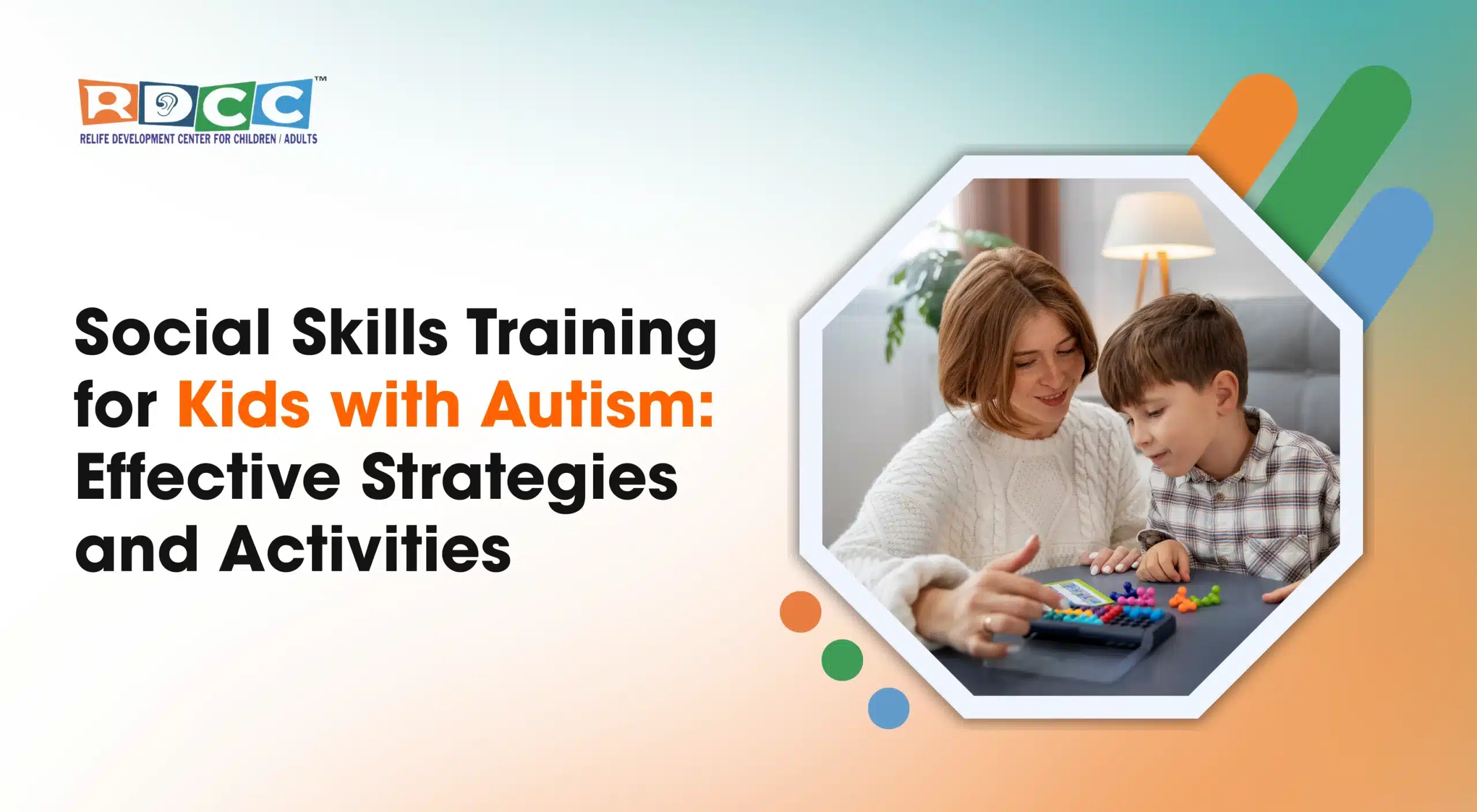
Social skills are the bedrock for strong social, interpersonal, and effective communication. But children with autism spectrum disorder (ASD) generally face challenges in navigating social interaction, such as in understanding non-verbal cues, maintaining conversations, and getting socially anxious frequently. However, with early interventions, emphasis on specifically targeted effective social skill training (SST), children with autism can make significant progress in forming meaningful connections and feel confident when engaging in social settings.
Social Skills Training for Kids with Autism: Effective Strategies and Activities
Here’s in this blog, we explore the different effective strategies and activities that promote social skill acquisition and empower Speech Therapy Techniques for Autism Children to thrive in a social environment without getting socially awkward and anxious.
Understanding Social Skills Challenges in Autism:
Children with autism more often face difficulties during interactions in social settings. These difficulties include:
Autistic children often face challenges in initiating or sustaining back-and-forth conversation, or are emotionally unable to connect with the context of a conversation, have difficulty in getting non-verbal cues, and reading body language, which often results in misunderstanding. Sometimes, a busy and noisy environment can overwhelm them, resulting in frustration and irritation.
Thus, in such scenarios, Social skill training delivered to them in a structured manner helps them in resolving these challenges by focusing on specific skills, and the importance of comfort while engaging in this leads to positive behavioural changes, because the ultimate aim is to help children with autism feel more confident and make them thrive in social and interpersonal communications.
Benefits of effective social skill training
Social skill training is essential for children with autism because it-
- Helps reduce social anxiety and develop confidence, which in turn benefits children when interacting in unfamiliar social settings.
- Improve verbal and non-verbal communication
- Inculcate confidence and knowledge to excel in academics
- Improves social and interpersonal communications, which result in a strong, independent, and confident personality and better peer relations.
- SST makes a profound impact on a child’s life, and they develop a more practical approach toward various environmental settings, like how to interact in the classroom, public, or family gatherings.
Incorporating evidence-based strategies and engaging activities, teachers, therapists, and parents can provide a positive and healthy learning environment that promotes social growth. Programs aiming to improve social skills rely primarily on child-facilitator interaction, but the need for trained facilitators is one of the primary barriers to treatment. Thus, novel methods of SST delivery include the use of Behavioral Intervention Technologies, technology-based interventions aimed at producing positive behavioral and psychological changes.
Effective strategies that work best for Social Skill Training
Social skills training (SST) not only involves teaching words like ‘thank you’ or ‘sorry’ and ‘please’ to children, but it is also one of the most common interventions to help address social deficits in individuals with autism spectrum disorder. Traditional SST teaches children with ASD to interact with their peers by providing face-to-face, in vivo instruction on conversation, friendship, and the benefits of Play Therapy.
Here are details about proven strategies to support social skills development in children with autism:
Involvement of Parents and Guardians
Parents play a very active and important role in reinforcing social skills at home. Many parents opt for Training programs like the Program for the Education and Enrichment of Relational Skills (PEERS) that teach parents how to coach their children in real-world settings, such as playdates or family gatherings.
Peer-Mediated Interventions
It is proven to be one of the most effective strategies in social skill training, where social skills learned from one peer can generalize their behaviour with different peers.
This approach is good for neurotypical peers because it generates empathy and social advocacy skills. Peers can model appropriate behaviors, initiate interactions, and provide natural opportunities for practice. For example, a peer might invite a child with autism to join them in some fun activities or games, with guidance from an adult.
Personalised Assessment and Goals
SST does not always have a one size all fit approach; every child with autism has different needs which are unique in themself, so the method of training usually begins only after thoroughly assessing their strengths, challenges, and interests.
Tools like the Social Skills Checklist or Vineland Adaptive Behavior Scales can help identify areas for growth, such as turn-taking, eye contact, or understanding emotions.
Set specific, measurable goals, such as “Rohan will initiate a conversation with a peer twice during playtime.”
Modeling and Role-Playing
These techniques can be effective for high-functionally autistic children who usually understand the concept but face difficulty and problems while using them randomly during a conversation. Thus, modeling involves demonstrating appropriate social behaviors for the child to observe and imitate by focusing not only on words but learning and studying body language.
For example, a parent might model how to greet someone by saying, “Hello, how are you?” or create scenarios of social gatherings and how to behave there. Role-playing allows kids to practice these behaviors in a safe, controlled setting. For instance, practice introducing themselves or asking for help using scripts or prompts.
Social Stories and Visual Supports
Visual tools and social stories are important means of teaching for children who are struggling with conceptual communication. Stories are usually short, personalized narratives that describe a social situation, and visual aid involves the use of storyboards for group games, cue cards to express emotions like a smiley face for a happy mood, and a sad emoji face to show sadness, etc. These techniques provide clear and concrete guidance for social interactions. Parents and therapists can reinforce these aids in children’s daily activities.
Visual aids and social stories are more fun and less boring for children, thus they reduce stress and anxiety by preparing children for new experiences and enhance better understanding and learning with a long-lasting effect.
Positive Reinforcement
Reinforce desired behaviors with praise, rewards, or tokens. For example, if a child makes eye contact during a conversation, offer specific praise like, “Great job looking at me while we talked!” Positive reinforcement motivates kids to repeat social behaviors.
Sensory Integration Support
Since sensory sensitivities can interfere with social engagement, incorporate sensory breaks or accommodations. For example, provide noise-canceling headphones in loud environments or allow fidget tools to help kids stay focused during social activities.
Engaging Activities for Social Skills Development
Engaging, fun, interactive activities can make social skills training enjoyable and effective. Here are some activities tailored for children with autism:
- Storytelling Time – Parents can take turns telling stories to improve the listening and imagination of kids.
- Group Singing or Dancing – these activities are especially good for encouraging coordination, imitation, and social participation.
- Emotion Matching Games – Use flashcards that show different facial expressions to teach emotional recognition.
- Cooking or Crafting as a Team – Encourages your kids to help you in the cooking, crafting, and other activities like gardening. It encourages cooperation and following instructions.
- Board Games – games help in practicing patience, turn-taking, and handling wins or losses gracefully.
- Pretend Play – Role-play scenarios like visiting a doctor, going to school, or shopping.
- Sharing Basket Activity – Have each family member share something they like to improve confidence and expression.
Conclusion
Social skills training for kids with autism is a powerful and effective way to help them navigate the complexities of human interaction. By combining evidence-based strategies like modeling, social stories, and visual supports with engaging activities like games and role-playing, parents and educators can create a supportive environment for growth. With patience, consistency, and individualized approaches, children with autism can develop the confidence and skills needed to form meaningful connections and thrive in social settings. Start small, monitor progress, celebrate little progress, and leverage the child’s unique strengths to unlock their social potential.
Frequently Asked Questions (FAQs)
What is social skills training for children with autism?
Social skills training (SST) is a structured program that helps children with autism learn how to interact, communicate, and build relationships with others. It teaches skills like making eye contact, starting conversations, sharing, and understanding emotions.
Ideally, at what age should social skills training begin?
Early intervention is ideal. Social skills training can start as early as 3 to 4 years old, once the child begins interacting with peers or attending preschool.
How can parents help develop social skills at home?
Parents by encouraging playdates or family interactions, or by modelling appropriate greetings and manners and by Praising efforts when the child uses positive social behavior can help in developing social skill at home.
How long does it take to see improvement in social skills?
Usually, the Progress varies by child. With consistent therapy and home support, many children begin showing noticeable improvement within 3 to 6 months, but long-term practice is often necessary.
Can online social skills training be effective?
Yes. Online programs and teletherapy sessions can be effective if interactive and guided by professionals. They often include virtual games, video modeling, and parent participation.

RDCC Healthcare
Related Posts
Effects of Poor Sleep on Health, Mental Well-Being, and Productivity
Sleep is one of the most important foundations of good health, yet it is often…
The Difference Between Speech Therapy and Occupational Therapy
Speech therapy and occupational therapy are different but complementary to each other. They are designed…


