

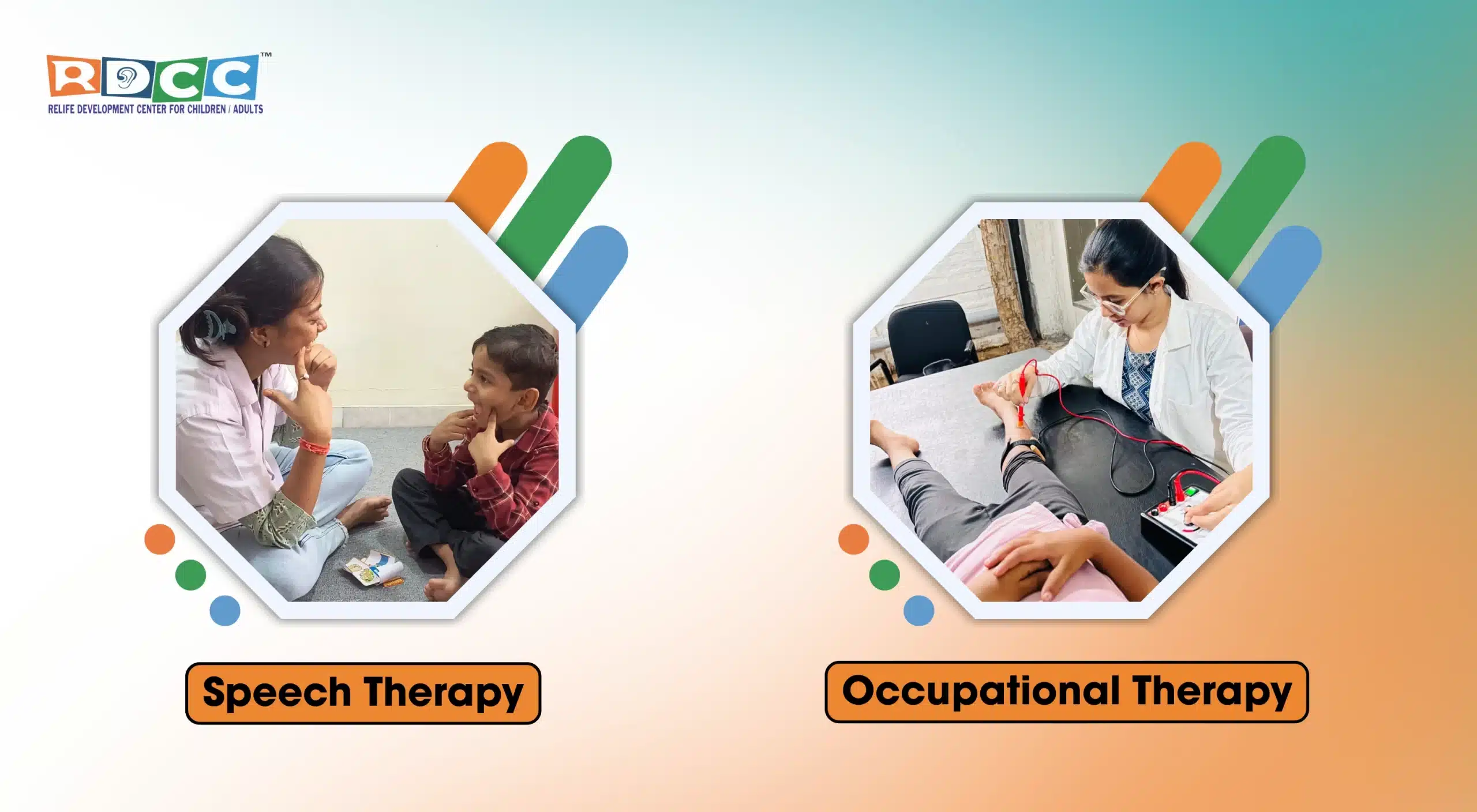
Speech therapy and occupational therapy are different but complementary to each other. They are designed to help children or adults who struggle with communication, basic daily activities, motor skills, or who show difficulty in learning.
Generally, both of them are mistaken as the same, but both of them serve different purposes, where speech therapy, also known as Speech Language Pathology, deals with communication, speech sound (articulation), and voice quality, whereas occupational therapy focuses on enabling independence in occupations that are important for day-to-day functioning.
In this detailed article, we’ll help you solve questions like “What is speech therapy?” “What is Occupational therapy?” “Difference between speech and occupational therapy”, and the benefits of early interventions.
What Is Speech Therapy?
Speech Therapy focuses on improving communication skills, including speech, language, voice, and swallowing. It is conducted by a licensed professional known as a Speech-Language Pathologist (SLP).
Speech therapy helps individuals who have difficulty expressing themselves, understanding others, or producing clear sounds.
What Does Speech Therapy Address?
Speech therapy targets a wide range of challenges, such as:
| Speech Disorders | Language Disorders | Social Communication Issues | Voice and Swallowing Disorders |
| Articulation problems (unclear sounds) | Delayed language development | Pragmatic language difficulties | Hoarse or weak voice |
| Phonological disorders | Difficulty understanding spoken language (receptive language) | Trouble with conversation skills | Feeding and swallowing difficulties |
| Stuttering or fluency issues | Difficulty expressing thoughts (expressive language) | Autism-related communication challenges | Oral motor coordination issues |
| Apraxia of speech |
Speech therapy aims to improve clarity, comprehension, and effective communication.
Who Needs Speech Therapy?
Speech therapy is commonly recommended for:
- Children with speech delay
- Children who show visible signs of learning difficulties
- An individual recovering froma brain injury or one who suffered from a stroke
- Child or adult with Dysarthria and Apaxiaor in simple term voice disorders
- An individual with fluency issues( stuttering)
- People suffering from dysphagia, i.e., difficulty in eating, drinking, chewing, and swallowing.
Early intervention can significantly improve outcomes.
What Is Occupational Therapy?
Occupational therapy focuses on helping individuals perform daily life activities in a more efficient way and independent way. Occupation in occupational theory stands for self- care, personal tasks, basic skills, and small school tasks in the case of children.
Thus, it is always recommended to prefer a licensed occupational therapist for visible results because they not only work on handling physical and mental strength but also help with motor skills as well as cognitive development.
What Does Occupational Therapy Address?
Occupational therapy targets functional abilities required for everyday living.
| Fine Motor Skills | Gross Motor Skills | Sensory Processing Issues | Day-to-day Life Skills |
| Handwriting | Balance and posture | Over- or under-sensitivity to sound, touch, or light | Dressing on one’s own |
| Buttoning up clothes | Body coordination | Difficulty in regulating emotions | Self Feeding |
| Cutting with knives | Core strength | Sensory-seeking behaviors | Toileting without help or supervision |
| Grasp strength and coordination | Motor planning | Hygiene |
OT helps individuals function better in home, school, and work environments.
Who Needs Occupational Therapy?
Occupational therapy is beneficial for:
- Individuals with Autism or attention-deficit hyperactivity disorder (ADHD)
- Children with developmental delays i.e takes longer than normal to learn social cues
- Children with sensory processing disorder
- Aged people who suffer from mobility or cognitive disorders
- An individual who is suffering from physical disabilities
- An individual who recently gotten a physical injury or is recovering from surgery
Key Differences Between Speech Therapy and Occupational Therapy
| Aspect | Speech Therapy | Occupational Therapy |
| Focus Area | Communication & swallowing | Daily living & motor skills |
| Therapist | Speech-Language Pathologist | Occupational Therapist |
| Primary Goal | Improve speech and language | Improve functional independence |
| Skills Targeted | Speech sounds, language, voice | Motor, sensory, cognitive skills |
| Common Age Group | Children & adults | Children, adults & elderly |
How Speech Therapy Works
Speech therapy sessions may include: Sound repetition exercises to get the child familiar with different sound frequencies, Language games and storytelling to develop more curiosity in the child, Oral motor strengthening exercises to help in the proper development and movement of oral muscles, Social communication role-play to make them accustomed to social settings, and feeding, swallowing, and drinking techniques.
All these activities help in reducing anxiety and improving cognitive skills. Sessions are often playful for children and structured for adults.
How Occupational Therapy Works
Occupational therapy sessions may involve: Hand strengthening activities, integrated Sensory exercises, Fine motor skill games, mimic daily tasks or activities.
Occupational therapy often takes place in environments that replicate real-life tasks or activities. It provides a more comforting environment to learn.
Also read: Occupational therapy activities for adhd children
Speech Therapy vs Occupational Therapy for Children
| When Speech Therapy Is Needed | When Occupational Therapy Is Needed |
| The child is not speaking or has a limited vocabulary | Difficulty holding a pencil |
| Speech is unclear for the age | Poor coordination or balance |
| Difficulty understanding instructions | Sensory meltdowns |
| Poor social communication | Trouble with self-care tasks |
Some children may require both therapies simultaneously.
Do Speech Therapy and Occupational Therapy Work Together?
Yes. In many cases, speech therapy and occupational therapy complement each other.
Examples
- A child with autism may receive speech therapy for communication and OT for sensory regulation.
- A stroke patient may need speech therapy for swallowing and OT for daily activities.
- A child with developmental delay may benefit from both language and motor skill development.
Collaborative therapy leads to holistic progress.
How to Decide Which Therapy Is Right
A professional evaluation is essential.
Consider Speech Therapy If
- Communication is the main concern
- Speech clarity is poor
- Language development is delayed
Consider Occupational Therapy If
- Daily tasks are difficult
- Motor coordination is weak
- Sensory issues affect behavior
In many cases, a multidisciplinary assessment provides the best clarity.
Benefits of Early Therapy Intervention
People generally ignore early signs and the need for early interventions.
Early interventions result in faster skill development, help in reducing anxiety and frustration and behavioral issues arising from it, which also boost confidence and impart more independence behavoural tendencies.
The results of early interventions and regular therapies can be seen in the form of better academic performances and more socialially outcome for the child. Early interventions and professional support make long-term development and success more achievable.
Misconceptions About Speech and Occupational Therapy
There are several misconceptions associated with speech and occupational therapy, some of which include:
- Only severe cases need therapy: this is wrong because early interventions help significantly.
- Replacement of different therapies with one: different therapies have different developmental roles and thus need to be given separately.
- Children outgrow delays on their own: Therapy accelerates healthy development
Conclusion
To conclude, we can say that though speech and occupational therapy appear to be similar, both of them are designed to serve different purposes. But both can be integrated if prescribed for better results because speech therapy focuses on communication skill on the other hand, occupational therapies are designed to help individuals develop skills and potential to work independently.
In this article, we have explained the difference between these two therapies along with their benefits to help parents, caregiver and individuals to select the right therapy according to their needs.

RDCC Healthcare
Related Posts

Effects of Poor Sleep on Health, Mental Well-Being, and Productivity
Sleep is one of the most important foundations of good health, yet it is often…

Occupational Therapy Activities for ADHD Children Ages 4–7: A Parent’s Guide
Occupational therapy for Attention Deficit Hyperactivity Disorder (ADHD) children focuses on helping with their day-to-day…


