

Every child has a different way of learning. Some children pick up new concepts quickly, while others need more time, repetition, encouragement, or a different way of being taught. As a parent, it is natural to wonder whether your child is simply learning at their own pace or may need some additional support.
Sometimes, the signs are quite small. A child may regularly struggle to follow instructions, find schoolwork frustrating, have difficulty staying focused, or need extra help with everyday tasks. When these challenges continue and begin affecting learning or daily life, exploring Special Education in Valsad may help parents understand what kind of support could make learning easier and more meaningful.
At RDCC Healthcare, special education is approached by looking at the child as an individual. Their strengths, interests, learning style, abilities, and areas where they need support can all be considered rather than expecting every child to learn in the same way.
What Is Special Education?
Special education is an individualised approach to learning for children who may need additional educational support. It can help children work on academic learning as well as communication, attention, social interaction, behaviour, functional abilities, and independence, depending on their individual needs.
A child may benefit from special education because of learning difficulties, developmental differences, Autism Spectrum Disorder (ASD), ADHD, intellectual disabilities, communication challenges, or other concerns that make traditional learning approaches difficult.
Importantly, special education does not mean that every child needs the same programme. One child may need help with reading and writing, while another may need more support with communication, attention, following instructions, or everyday skills.
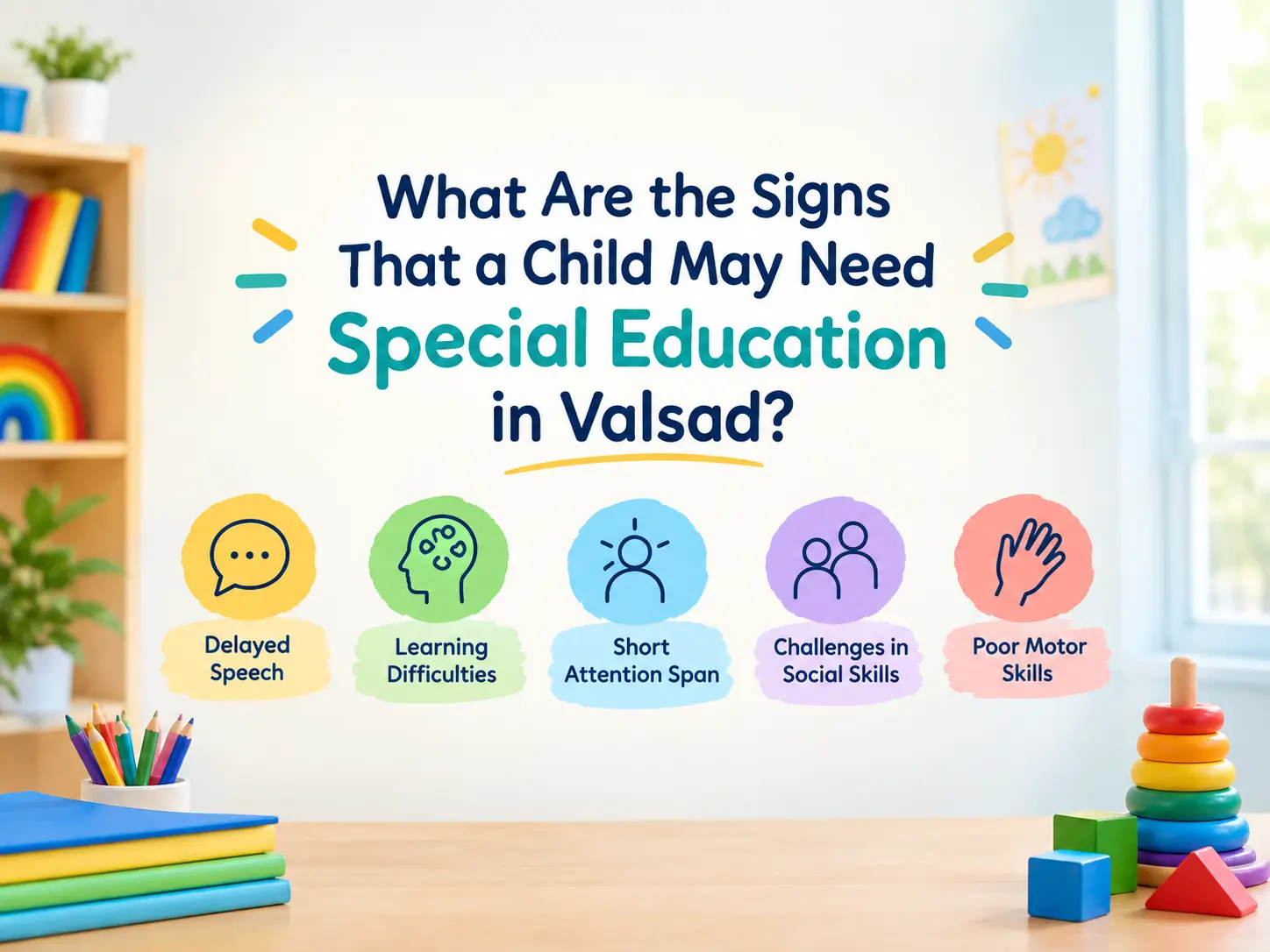
What Are the Signs That a Child May Need Special Education in Valsad?
There is no single sign that automatically means a child needs special education. Children develop at different rates, and having an occasional difficulty is completely normal.
However, when certain challenges happen regularly, continue over time, or make school and everyday activities difficult, parents may want to understand the situation more closely.
Difficulty With Academic Learning
Some children may continue to struggle with basic academic concepts even after regular practice and classroom teaching.
You may notice that your child has difficulty recognising letters or numbers, reading simple words, writing, remembering previously taught concepts, or understanding basic mathematical ideas.
This does not mean the child cannot learn. It may simply mean that the child needs concepts to be explained differently, broken into smaller steps, or practised more often.
Difficulty Following Instructions
Does your child often say, “I don’t understand,” even when the instruction seems simple? Or do they start a task but forget what they were asked to do?
Difficulty following spoken or multi-step instructions can affect both classroom learning and everyday routines. Individualised teaching can make instructions easier to understand by using simpler steps, repetition, demonstrations, or visual support when appropriate.
Trouble Staying Focused
Children naturally get distracted, but frequent difficulty staying engaged during learning activities may affect their progress.
A child may start an activity but quickly move on to something else, need repeated reminders, leave work unfinished, or find it difficult to stay engaged with age-appropriate tasks.
Attention difficulties can have different causes, so it is important not to assume that every child who struggles to concentrate has the same underlying need.
Communication Difficulties
Communication plays an important role in learning. A child may know what they want to say but struggle to express it, or may find it difficult to understand questions, conversations, or classroom instructions.
Parents may notice limited vocabulary, difficulty answering questions, trouble expressing needs, or challenges understanding spoken information.
When communication difficulties affect education, special education can be considered alongside appropriate speech and language support based on the child’s needs.
Difficulty With Social Interaction
Some children find it harder to interact comfortably with other children. They may have difficulty taking turns, sharing, starting conversations, responding to peers, or understanding social situations.
For children with Autism or other developmental differences, educational support may include opportunities to develop communication, social participation, classroom learning, and functional skills.
A School for Special Needs in Valsad may offer a more individualised learning environment where these areas can be addressed according to the child’s requirements.
Difficulty Becoming Independent
Learning is not limited to reading, writing, and mathematics. Children also gradually develop skills that help them manage everyday activities more independently.
A child may need additional help with following routines, organising belongings, completing simple tasks, transitioning between activities, or managing age-appropriate daily responsibilities.
Special education can include functional learning when these skills are relevant to the child’s individual goals.
Learning at a Different Pace
Some children simply need more time to understand a concept. They may benefit from repeated practice, hands-on activities, visual learning, or one-to-one guidance.
If your child consistently needs a different pace or teaching method, personalised education may help make learning feel less overwhelming.
The focus should not be on how quickly one child learns compared with another. It should be on understanding what helps that particular child learn more comfortably.
Which Children May Benefit From Special Education?
Special education may be useful for children who need additional support with learning, communication, development, behaviour, or everyday skills.
Children With Different Learning Needs
Depending on individual assessment and requirements, special education may support children with:
- Autism Spectrum Disorder (ASD)
- ADHD
- Learning difficulties
- Developmental delays
- Intellectual disabilities
- Communication difficulties
- Academic learning challenges
- Social or functional skill difficulties
Having a particular diagnosis does not automatically mean that a child needs the same type of educational programme as another child with the same diagnosis.
Every child has a different combination of strengths and challenges. This is why individualised planning is so important.
Children Who Need a Different Learning Approach
Some children learn better when concepts are demonstrated rather than only explained verbally. Others may need repetition, visual cues, practical activities, or shorter learning tasks.
A personalised approach can help educators understand which methods are more comfortable and effective for the child.
This is where Special Education in Valsad can provide additional support beyond simply repeating the same teaching method.
How Can a School for Special Needs in Valsad Support a Child?
Choosing an educational environment can feel like a big decision for parents. You want your child to feel understood, comfortable, and encouraged while also having opportunities to learn and develop.
A School for Special Needs in Valsad can provide a more individualised approach for children who require additional educational support.
Depending on the child’s needs, learning may include academic concepts along with communication, attention, social participation, functional abilities, and independence.
Personalised Learning
Rather than expecting every child to complete activities in the same way, educators can adjust the pace, instructions, activities, and level of support according to the child’s abilities.
Practical Skill Development
Learning can also include practical activities that help children become more independent in everyday situations. These skills may be incorporated alongside academic learning where appropriate. Children who need support with coordination, fine motor skills, sensory needs, self-care, or everyday activities may also benefit from Occupational Therapy in Valsad.
Communication and Social Support
For children who find communication or social interaction challenging, learning activities can provide opportunities to practise expressing needs, responding to others, following conversations, taking turns, and participating in group activities.
Consistent Encouragement
Children often learn better when they feel safe enough to make mistakes and try again. Patient encouragement and positive reinforcement can help create a more comfortable learning experience.
How Does Special Education Support Children With Autism and ADHD?
Children with Autism and ADHD can have very different learning needs. Some children may have strong academic abilities but need help with attention, communication, transitions, organisation, or social interaction. Others may need more extensive support across several areas.
For children with Autism, educational support may focus on communication, structured learning, social participation, functional skills, routines, and academic development according to individual needs.
For children with ADHD, support may involve strategies for maintaining attention, following instructions, completing activities, managing transitions, and staying organised during learning.
The important thing is to understand the child rather than focus only on a diagnosis. Special Education in Valsad can be personalised around the child’s actual strengths, challenges, and learning goals.
What Should Parents Look for in a School for Special Needs?
When exploring a School for Special Needs in Valsad, parents may have many questions. There is no single feature that works for every child, but understanding the educational approach can help families make a more informed decision.
Parents may look for an environment that:
- Understands individual learning differences
- Creates personalised learning goals
- Considers the child’s strengths
- Adjusts teaching methods when required
- Supports communication and social development
- Encourages functional and independent skills
- Provides individual attention where needed
- Tracks progress over time
- Maintains communication with parents
- Creates a supportive and comfortable learning environment
It can also be helpful for parents to ask how educators understand a child’s progress and how learning goals are adjusted as the child develops.
Why Early Educational Support Can Be Helpful
It is completely understandable for parents to hope that a child will eventually catch up. Children do develop at different rates, and not every difficulty requires specialised education.
At the same time, if concerns continue for months and begin affecting schoolwork, communication, participation, or daily activities, getting a better understanding of the child’s needs can be helpful.
Early support can provide more opportunities for children to practise skills, understand concepts, build confidence, and develop greater independence.
The goal is not to compare the child with classmates. It is to understand what the child needs today and provide appropriate opportunities to grow from there.
Special Education in Valsad at RDCC Healthcare
At RDCC Healthcare, special education focuses on understanding each child’s individual learning needs rather than following a one-size-fits-all approach.
The child’s abilities, strengths, learning style, communication, attention, developmental needs, and areas requiring additional support can all be considered while planning educational activities.
For parents searching for Special Education in Valsad or exploring a School for Special Needs in Valsad, the focus is on creating meaningful learning opportunities where children can develop skills at a pace suited to their needs.
Every small step matters. Understanding a new concept, completing an activity independently, communicating a need, or becoming more comfortable in a learning environment can all be meaningful parts of a child’s progress.
Conclusion
Every child deserves to experience learning in a way that feels supportive and understandable. Struggling with schoolwork, communication, attention, social interaction, or everyday activities does not define what a child can achieve. Recognizing ongoing difficulties can simply be the first step towards understanding what kind of support may help. Special Education in Valsad can give children personalised opportunities to learn, practise important skills, and become more confident at their own pace. For parents considering a School for Special Needs in Valsad, RDCC Healthcare focuses on individual learning needs and meaningful development, helping children move forward through patient guidance, consistent support, and personalized education.
Frequently Asked Questions
1. How do I know if my child may need special education in Valsad?
Regular difficulty with academic learning, following instructions, communication, attention, social interaction, or everyday skills may be a reason to explore additional educational support. A professional assessment can help parents understand the child’s individual needs more clearly.
2. Who can benefit from Special Education in Valsad?
Children with learning difficulties, Autism, ADHD, developmental delays, intellectual disabilities, communication challenges, or other educational needs may benefit from special education. The type of support should be based on each child’s individual abilities and requirements.
3. What does a School for Special Needs in Valsad offer?
A School for Special Needs in Valsad may provide individualised learning and support. Depending on the child, this can include academic learning, communication, attention, social participation, functional skills, and independence.
4. Can special education help children with Autism?
Yes. Special education can provide individualised learning opportunities for children with Autism. Educational goals may include academic development, communication, social participation, routines, and functional skills depending on the child’s needs.
5. Can children with ADHD benefit from special education?
Some children with ADHD may benefit from personalised educational strategies when attention, organisation, following instructions, or task completion affects learning. The appropriate approach depends on the individual child.
6. Is special education only for children with learning disabilities?
No. Special education can support children with a range of learning, developmental, communication, intellectual, behavioural, and functional needs. Support is generally tailored according to the child’s specific requirements.
7. How can parents explore special education in Valsad?
Parents can start by discussing their concerns with an appropriate professional and understanding their child’s strengths and areas of difficulty. They can then explore educational settings and support options that match the child’s individual needs.

Related Posts

Effective Remedial Education Strategies
Remedial education plays a crucial role in helping students who struggle academically. At RDCC Healthcare,…

What Are the Signs of Special Education Needs?
Every child develops at their own pace, but when delays or difficulties become apparent in…



