

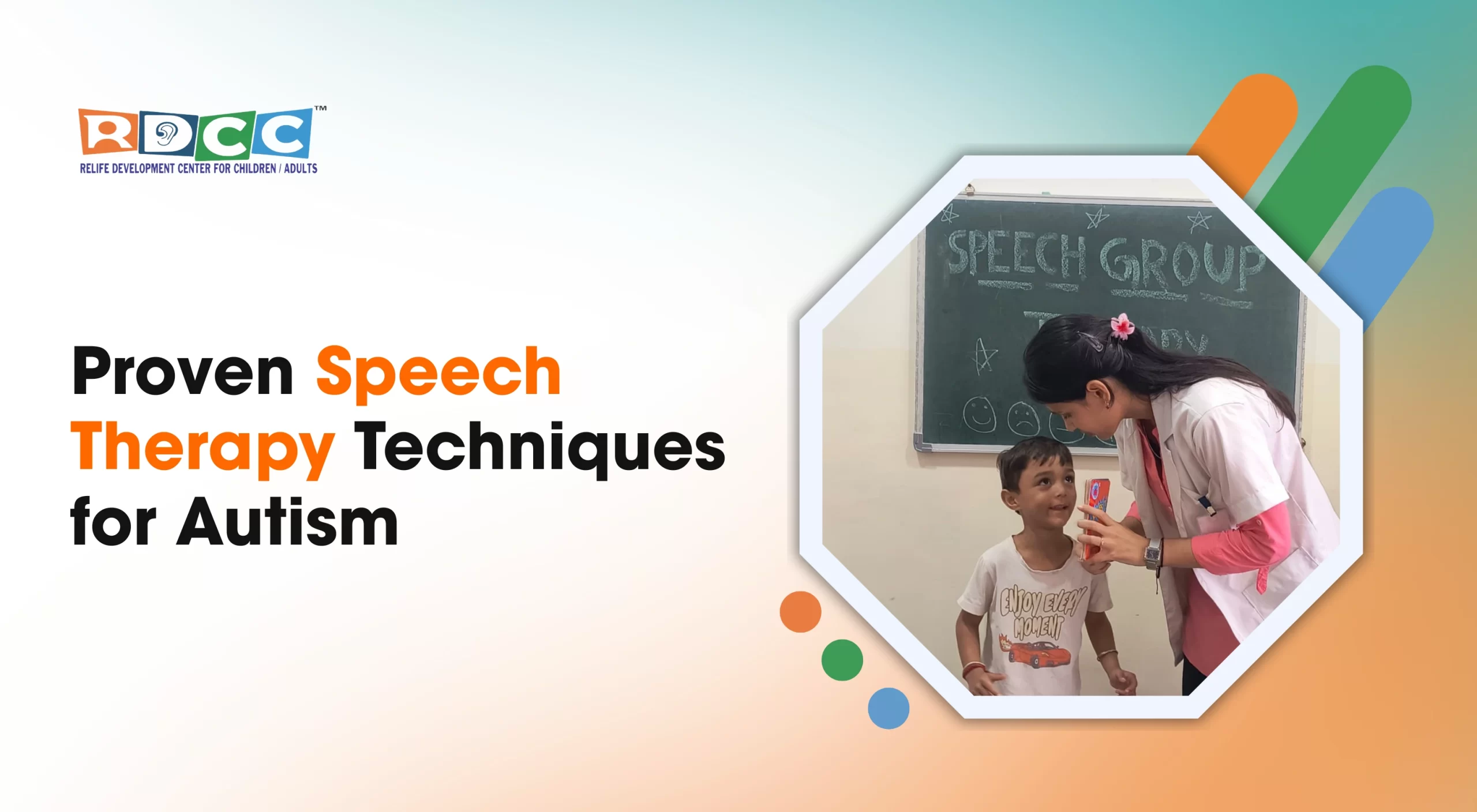
Autism, also known as autistic spectrum disorder, is a condition characterised by differences or difficulties in social communication and interactions. ASD often affects a child process and express himself, thus this often leads to nervousness, challenged verbal communication, and social anxiety while speaking in a social setup.
Parents in such situations can get an overwhelming feeling, but then speech therapy offered by speech therapists like us and many more can be a glimmer of hope.
Proven speech therapy techniques for Autism are not just clinical tools, but they act as a bridge between the thoughts and communication in an autistic person, along with providing them confidence for self-expression.
Backed by various research organisations, these methods focus mainly on early interventions, and here’s how proven therapies and activities recommended at a therapy session at a clinic or by a private certified therapist transform the lives of such children.
Before diving deep into techniques, we need to understand what speech challenges are in autism.
Understanding Speech Challenges in Autism
Children with Autism generally experience a diversity of communication issues like speech delay including problems like speech delay in children and problems like rhotacism (difficulty with ‘r’ sounds), sigmatism (difficulty with ‘s’ and ‘z’ sounds), lambdacism (difficulty with ‘l’ sound), echolalia (repeating phrases), or complete nonverbalism.
According to the American Speech-Language-Hearing Association (ASHA), a leading institute in research, up to 30% of autistic children remain nonverbal into adulthood if not intervened upon.
Autistic challenges arise from neurological differences affecting social skills, sensory processing, and motor planning for speech sounds. For example, a child may recognise words but still struggle to frame them due to oral-motor problems or other sensory sensitivities.
But the good news, or we can say beacon of hope in such situations, is early speech therapy, which can significantly improve the outcomes. Much research on the same topics shows that early interventions as early as from the age of 3 years can boost language acquisition by up to almost 50%.
Speech-language therapy has different tailored approaches to each child’s needs, focusing on expressive language (speaking), receptive language (understanding), and pragmatic skills (social use of language). At home, parents can extend these gains through everyday interactions, turning mealtime or playtime into therapy opportunities.
Speech therapy for autism isn’t a one-size-fits-all fix — it’s a partnership. SLPs and therapists collaborate with families to track progress via individualised education programs (IEPs), ensuring techniques align with your child’s strengths, like a love for music or animals.
By blending clinic-based structure with home-based practice, here’s in this article, we discuss in detail these proven speech therapy techniques for autism, which can create lasting neural pathways for communication.
8 Evidence-Based Speech Therapy Techniques
The base of an effective autism speech therapy is methods that are validated by rigorous research. According to the National Clearinghouse on Autism Evidence and Practices, there are 28 evidence-based practices that are helpful in speech development.
Some of these techniques, like augmentative and alternative communication (AAC), oral-motor exercise, music, and other functional communication techniques, are effectively proven techniques that have helpful activities that work well at home as well as at therapy.
Because home is where reinforcement happens, turning therapy into a habit. These activities, drawn from SLP recommendations, are low-cost, engaging, and backed by parent-implemented intervention research — proven to extend clinic gains. Aim for 10-15 minutes daily, following your child’s lead to avoid overwhelm.
-
1. Augmentative and Alternative Communication (AAC)
For children with limited verbal skills, AAC is a cornerstone. Using tools like speech-generating devices or apps like Proloquo2Go or TouchChat can be a life-changing experience for autistic kids.
The picture exchange communication system (PECS) for example, here’s a child give picture of desired food items, or any other item to teacher to get it, then child pick up picture of ‘I want’ or ‘I don’t want’ with the earlier picked picture before handling it to their other communication partners. Thus, here focus is on gradual development where children learn to form sentences.
Many studies also confirm that PECS increases effective communication by approximately 70% in young autistic children.
Other than above mentioned methods, at home parents can also reinforce AACs by placing picture cards on the wall of the children’s room for them to use when they need something or by placing picture cards on the fridge for snack requests.
These techniques overall reduce frustration and anger in children that arises due to a communication barrier, and also help in developing independent communication.
-
2. Functional Communication Training (FCT)
FCT teaches replacement behaviours for frustration-driven outbursts, where words or signs are used instead of tantrums. Parents can also explore speech therapy activities for children that encourage clear communication and self-expression.
It is a commonly used method according to Applied Behaviour Analysis (ABA), which uses positive reinforcement, praise, or reward methods to shape more acceptable and calm responses. Several studies have found that FCT can reduce problematic behaviour by up to 80% along with other solicited skills.
Therapists in sessions might prompt a child to say “more” during a game, rewarding success with continued play and appreciation. Parents can adapt this at home by narrating routines: “Time for bath — say ‘water’ for bubbles!”
-
3. Oral-Motor Exercises and Articulation Drills
Apraxia (difficulty in skilled movements) and the inability to coordinate mouth muscles are challenges commonly faced by many autistic children. This also results in speech delay in 4-year-olds.
Thus, techniques like jaw strengthening or lip massage, along with chewy tubes, improve speech clarity over time.
Clinical sessions or professional therapy sessions also use mirrors for visual feedback, while parents at home can use silly faces during mirror time because visual interpretations or mirror play boost articulation and imitation and are more likely to be processed better by autistic children.
-
4. Social Narrative and Video Modelling
Social stories use simple narratives, personalised scripts, etc., to explain social scenarios and emotions. This method, according to researchers, proves to be about 60% effective in eliminating social anxiety and developing social initiations like sharing, carrying, and taking turns in completing tasks or playing community games.
This activity helps children understand the context behind several small gestures and different emotional reactions in different scenarios. Parents, through bedtime stories or moral stories, can guide the child’s righteous development.
-
5. Singing Music and Improvisational Therapy
Music therapy leverages rhythm for language patterns. Receptive listening to songs builds vocabulary, while improvisational jamming encourages turn-taking. A PMC review highlights its efficacy in reducing anxiety during sessions.
These techniques form the backbone of proven speech therapy techniques for autism, adaptable across settings for holistic growth.
Songs like “Wheels on the Bus” teach directions and body parts through melody and motion. Gestures amplify learning — point to wheels while singing. Research indicates music aids prosody (speech rhythm) in autistic kids.
Even at home, parents can encourage children to sing after them by using repetitive rhymes from nursery poems and deliberately missing a few lines, encouraging them to finish the missing words.
-
6. Imitation Games: Building Mimicry and Turn-Taking
Actions like clapping, waving, or making animal sounds, then pause for your child to copy. This fosters joint attention, a key autism milestone. For verbal layers, say “clap” while demonstrating.
You can do it by using toys — roll a ball back and forth, labelling “my turn/your turn.” Reward with high-fives. Adapt for sensory needs by choosing soft textures.
-
7. Sensory Bins with Descriptive Play
Fill a bin with rice, beans, or water beads, hiding objects like toy animals. As your child explores, narrate: “Squishy slime! What color?” This targets sensory integration and vocabulary. Evidence from Autism Parenting Magazine shows tactile play reduces frustration in communication attempts.
-
8. Animal Sound Farmyard Play
Set up a toy farm and use sounds of different animals for easy identification, like moo for cows and oink for pigs. This leverages autistic children’s affinity for animals, easing into words. Also, pair them with books for repetition.
These easy home activities make therapy seamless, fostering confidence without pressure.
Concluding by Integrating Home & Therapy for Lasting Results and Empowering Voices
Weekly training sessions for parents bridge the gap, along with speech-language pathologists demoing techniques and tracking progress of a child with journals by noting down new words they have learned or monitoring reductions in meltdowns. Followed by feedback and patience, we can truly conclude that success hinges on collaboration.
Frequently Asked Questions
Yes, it is completely normal for a child to get frustrated or irritated during speech therapy, but with patience and using the child’s interests with some fun activities and rewards, therapy sessions can be more fun for them.
Many Autistic children face challenges with social communication and speech clarity due to either neurological deformities or social anxiety; thus, speech therapy helps them in gaining confidence and interacting better in social settings.
As early as you notice speech delay in your child, even as early as 18 months to 2 years of age.
Usually, the frequency of sessions depends on the child’s needs. Typically, weekly or biweekly sessions are recommended.
Parents can read picture books aloud, sing rhymes, practice naming objects, play imitation games, and use simple flashcards. Daily conversations during meals or playtime also build communication naturally.
Progress varies from child to child. Some show improvement within a few weeks, while others may take months. Consistent therapy, home practice, and family support are key factors.

Related Posts

Effects of Poor Sleep on Health, Mental Well-Being, and Productivity
Sleep is one of the most important foundations of good health, yet it is often…
The Difference Between Speech Therapy and Occupational Therapy
Speech therapy and occupational therapy are different but complementary to each other. They are designed…


