

Pure Tone Audiometry: Everything You Need to Know
Hearing is one of our most important senses, allowing us to communicate, connect with others, and stay aware of our surroundings. When hearing difficulties arise, a comprehensive hearing evaluation is often the first step toward identifying the problem and finding the right solution.
One of the most commonly used and reliable hearing assessments is Pure Tone Audiometry. This test helps audiologists measure a person’s hearing ability across different sound frequencies and volumes, making it an essential tool for diagnosing hearing loss.
Whether you’re experiencing hearing difficulties, have been referred for a hearing evaluation, or simply want to understand more about hearing health, this guide explains everything you need to know about Pure Tone Audiometry, including how it works, what to expect, and why it is important.
What Is Pure Tone Audiometry?
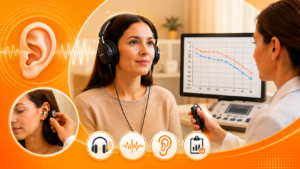
Pure Tone Audiometry (PTA) is a hearing test used to determine the softest sounds a person can hear at various frequencies. It helps identify the presence, type, and degree of hearing loss.
During the test, individuals listen to a series of tones through headphones and indicate whenever they hear a sound. The results are recorded on an audiogram, which provides a detailed picture of hearing ability.
Pure Tone Audiometry is considered one of the most accurate and widely used methods for evaluating hearing sensitivity and is commonly performed by audiologists and hearing healthcare professionals.
Why Is Pure Tone Audiometry Important?
Hearing loss can develop gradually and often goes unnoticed until communication becomes difficult. Pure Tone Audiometry helps detect hearing problems early, allowing for timely intervention and treatment.
The test can help:
- Diagnose hearing loss
- Determine the severity of hearing impairment
- Identify whether hearing loss affects one or both ears
- Monitor hearing changes over time
- Assess the effectiveness of hearing aids or medical treatments
- Assist in hearing aid selection and fitting
Early diagnosis can significantly improve communication abilities and overall quality of life.
Understanding Hearing Frequencies
To understand how Pure Tone Audiometry works, it helps to know a little about sound frequencies.
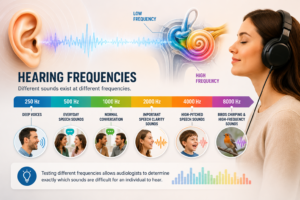
Frequency is measured in Hertz (Hz) and represents the pitch of a sound.
Examples include:
| Frequency Range | Common Sounds |
| 250 Hz | Deep voices |
| 500 Hz | Everyday speech sounds |
| 1000 Hz | Normal conversation |
| 2000 Hz | Important speech clarity sounds |
| 4000 Hz | High-pitched speech sounds |
| 8000 Hz | Birds chirping and high-frequency sounds |
Testing different frequencies allows audiologists to determine exactly which sounds are difficult for an individual to hear.
How Does Pure Tone Audiometry Work?
Pure Tone Audiometry measures the lowest intensity level at which a person can hear sounds across a range of frequencies.
The test involves:
Air Conduction Testing
Air conduction testing evaluates the entire hearing pathway.
The patient wears headphones and listens to tones presented at different frequencies and volumes. Each time a tone is heard, the patient signals the audiologist, usually by pressing a button or raising a hand.
This part of the test helps determine overall hearing sensitivity.
Bone Conduction Testing
Bone conduction testing evaluates how sound travels directly to the inner ear.
A small vibrating device is placed behind the ear on the mastoid bone. This bypasses the outer and middle ear and helps determine whether hearing loss is conductive or sensorineural.
Together, air and bone conduction testing provide a complete assessment of hearing function.
What Conditions Can Pure Tone Audiometry Detect?
Pure Tone Audiometry can help diagnose various hearing-related conditions, including:
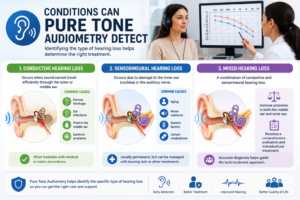
Conductive Hearing Loss
This occurs when sound cannot travel efficiently through the outer or middle ear.
Common causes include:
- Earwax blockage
- Ear infections
- Fluid in the middle ear
- Eardrum problems
Sensorineural Hearing Loss
This type of hearing loss results from damage to the inner ear or auditory nerve.
Common causes include:
- Aging
- Noise exposure
- Genetic factors
- Certain medications
Mixed Hearing Loss
Mixed hearing loss involves a combination of conductive and sensorineural hearing loss.
Pure Tone Audiometry helps identify the specific type of hearing loss and guides treatment recommendations.
Who Should Have a Pure Tone Audiometry Test?
A hearing assessment may be recommended for individuals who experience:
- Difficulty hearing conversations
- Frequently asking others to repeat themselves
- Ringing or buzzing in the ears (tinnitus)
- Trouble understanding speech in noisy environments
- Sudden hearing changes
- Workplace noise exposure
- Family history of hearing loss
- Age-related hearing concerns
Regular hearing evaluations can also be beneficial for individuals who want to monitor their hearing health proactively.
What Happens During a Pure Tone Audiometry Test?
Many people feel nervous before their first hearing test, but the procedure is straightforward and comfortable.
Step 1: Initial Consultation
The audiologist will discuss your symptoms, medical history, and any hearing concerns you may have.
Step 2: Ear Examination
Your ears may be examined using specialized equipment to check for earwax, infection, or structural abnormalities.
Step 3: Headphone Placement
You will wear headphones through which various tones are presented.
Step 4: Responding to Sounds
You will indicate whenever you hear a tone, even if it is very soft.
Step 5: Bone Conduction Assessment
If necessary, bone conduction testing will be performed using a small vibrating device placed behind the ear.
Step 6: Results Review
Once testing is complete, the audiologist will explain the results and discuss any recommended next steps.
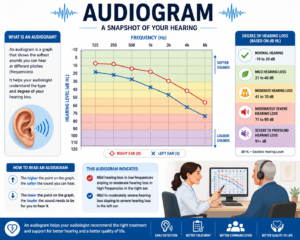
Understanding Your Audiogram
An audiogram is a graph that displays your hearing test results.
The graph shows:
Frequency
Displayed horizontally and measured in Hertz (Hz).
Hearing Level
Displayed vertically and measured in decibels (dB).
The audiogram helps identify:
- Which frequencies are affected
- Degree of hearing loss
- Differences between ears
- Appropriate treatment options
Audiologists use this information to create personalized hearing care plans.
Degrees of Hearing Loss
Pure Tone Audiometry can classify hearing loss into different categories.
Normal Hearing
0–25 dB
Individuals can hear most everyday sounds without difficulty.
Mild Hearing Loss
26–40 dB
Soft speech and distant conversations may be difficult to hear.
Moderate Hearing Loss
41–55 dB
Regular conversations become more challenging without amplification.
Moderately Severe Hearing Loss
56–70 dB
Understanding speech becomes increasingly difficult.
Severe Hearing Loss
71–90 dB
Most speech sounds are difficult to hear without assistance.
Profound Hearing Loss
91 dB and above
Very loud sounds may be required to detect speech and environmental noises.
Benefits of Pure Tone Audiometry
Pure Tone Audiometry offers numerous advantages for individuals concerned about their hearing.
Early Detection of Hearing Loss
Identifying hearing problems early allows for faster treatment and better long-term outcomes.
Accurate Diagnosis
The test provides detailed information about hearing ability across multiple frequencies.
Personalized Treatment Planning
Results help audiologists recommend the most appropriate hearing solutions.
Monitoring Hearing Changes
Regular testing helps track hearing health over time.
Improved Quality of Life
Timely diagnosis and intervention can improve communication, confidence, and daily functioning.
Preparing for a Pure Tone Audiometry Test
To ensure accurate results, consider the following tips:
- Avoid exposure to loud noise before the test
- Inform the audiologist about medications you are taking
- Share any symptoms or hearing concerns
- Arrive relaxed and well-rested
- Follow all instructions provided during the assessment
These simple steps can help ensure reliable test results.
How Often Should You Have a Hearing Test?
The frequency of hearing evaluations depends on age, lifestyle, and risk factors.
You may benefit from regular testing if:
- You are over the age of 50
- You work in noisy environments
- You have hearing loss in your family
- You use hearing aids
- You have ongoing tinnitus
- You notice changes in hearing ability
Routine assessments help maintain long-term hearing health and support early intervention when needed.
How RDCC Healthcare Can Help
At RDCC Healthcare, we provide comprehensive hearing assessments, including Pure Tone Audiometry, to help individuals understand and manage their hearing health.
Our experienced audiologists use advanced diagnostic equipment to evaluate hearing abilities accurately and recommend personalized solutions based on each patient’s unique needs.
Our hearing care services include:
- Pure Tone Audiometry testing
- Comprehensive hearing evaluations
- Hearing aid consultations
- Hearing aid trials
- Hearing aid repairs
- Ongoing hearing health support
Our goal is to help patients improve communication, maintain independence, and enjoy a better quality of life through expert hearing care.
Conclusion
Pure Tone Audiometry is one of the most effective and widely used methods for assessing hearing health. By measuring hearing sensitivity across different frequencies and sound levels, the test provides valuable information about hearing ability and helps diagnose various types of hearing loss.
Whether you’re experiencing hearing difficulties, have concerns about age-related hearing changes, or simply want to monitor your hearing health, Pure Tone Audiometry can provide the answers you need.
Early detection remains one of the most important steps in protecting your hearing and ensuring timely access to the most appropriate treatment and support.
Frequently Asked Questions
1. What is Pure Tone Audiometry?
Pure Tone Audiometry is a hearing test that measures the softest sounds a person can hear across different frequencies. It helps diagnose hearing loss and assess overall hearing health.
2. Is Pure Tone Audiometry painful?
No. Pure Tone Audiometry is completely painless and non-invasive. The test simply involves listening to sounds through headphones and responding when you hear them.
3. How long does a Pure Tone Audiometry test take?
Most Pure Tone Audiometry tests take approximately 20 to 45 minutes, depending on the individual’s hearing condition and whether additional assessments are required.
4. What can Pure Tone Audiometry diagnose?
The test can identify conductive hearing loss, sensorineural hearing loss, mixed hearing loss, and other hearing-related conditions affecting one or both ears.
5. Do I need to prepare for a hearing test?
Very little preparation is required. Avoid loud noise exposure before the test and inform your audiologist about any medications or hearing concerns.
6. Can children undergo Pure Tone Audiometry?
Yes. Pure Tone Audiometry can be adapted for older children who are able to respond reliably to sounds during testing.
7. What is an audiogram?
An audiogram is a graph that displays the results of a hearing test, showing hearing thresholds across different sound frequencies and helping audiologists determine the degree of hearing loss.
8. How often should I have a Pure Tone Audiometry test?
The frequency depends on your age, lifestyle, and hearing health. Individuals at higher risk of hearing loss or those experiencing hearing difficulties may benefit from regular hearing evaluations as recommended by an audiologist.

Related Posts
Why Choose the Best Audiologist in Vadodara for Hearing Loss Treatment Options?
Hearing plays an important role in how we communicate, learn, work, and stay connected with…

10 Common Signs You Need a Hearing Test
Hearing plays a vital role in our daily lives, helping us communicate, stay connected, and…






